
Why Four Post Automotive Lifts Fail Without the Right Rolling Bridge Jack
🧭Introduction: The Hidden Limitation of Four Post Automotive Lifts
Four post automotive lifts are often marketed as “complete solutions.”
In reality, many users discover a frustrating truth after installation:The lift is stable—but service flexibility is missing.
Tire removal, brake work, suspension inspection, and alignment prep all expose the same bottleneck: wheels stay on the runways. That’s where a properly designed rolling bridge jack—specifically the KT-RJ70 with 7,000 lb lifting capacity—changes how four post automotive lifts actually perform.
This article is built as a decision guide, not a spec dump. It helps you evaluate whether your four post automotive lifts setup is merely functional—or genuinely service-ready.
🧱What Four Post Automotive Lifts Are Expected to Do Today (Not Just Lift)
The role of four post automotive lifts has evolved.
They’re no longer just for parking or underbody inspection. Modern users expect them to:
● Support wheel-free service
● Handle repeated daily cycles
● Adapt to different vehicle sizes
● Maintain stability under dynamic loads
Without a rolling jack, four post automotive lifts remain structurally strong but operationally incomplete.
⚙️How Four Post Automotive Lifts Transform with the KT-RJ70 Rolling Bridge Jack
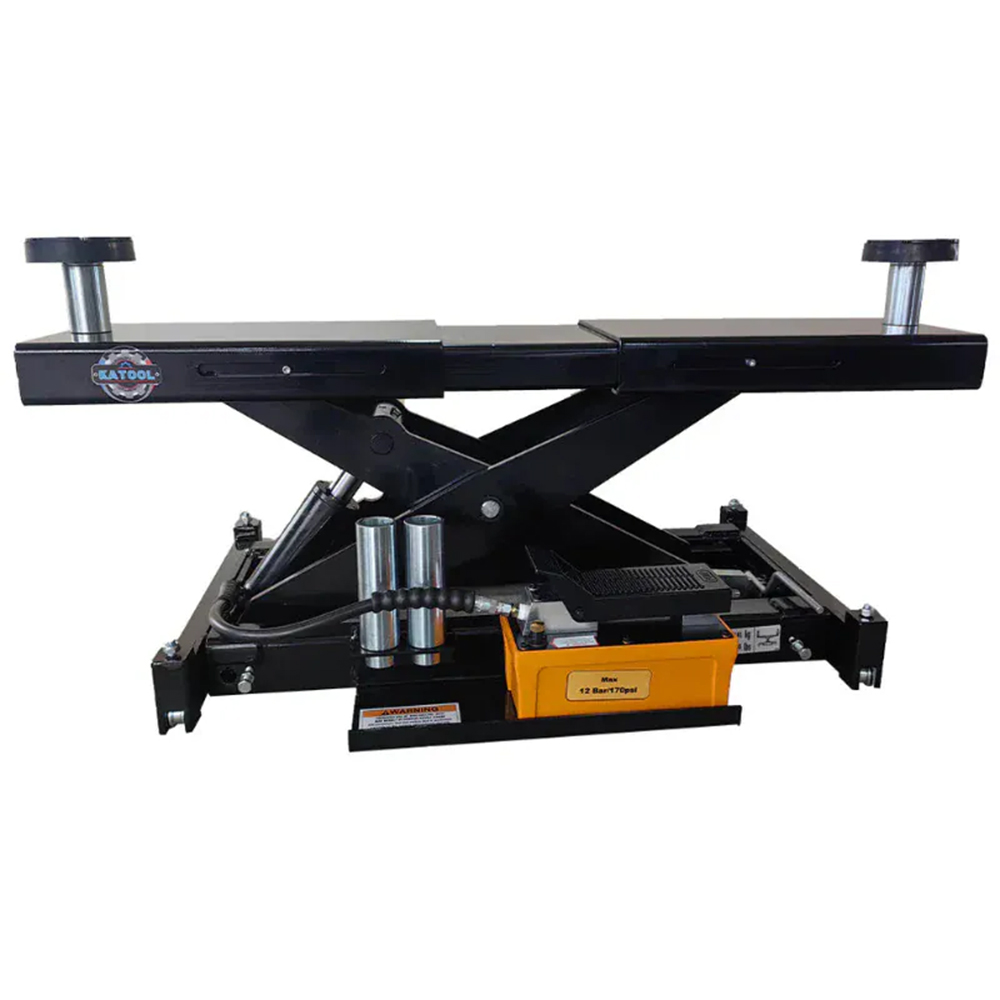
The KT-RJ70 rolling bridge jack is designed specifically to integrate with compatible four post automotive lifts, running smoothly along the internal rails beneath the runways.
🔩 How the KT-RJ70 works in practice:
● The vehicle is positioned on the runways
● The lift raises to service height
● The KT-RJ70 rolls laterally and longitudinally
● Adjustable lifting arms contact chassis points
● Wheels are lifted free for service
With a 7,000 lb lifting capacity, the KT-RJ70 comfortably supports most passenger vehicles, SUVs, and light trucks.
✅ Compatible four post automotive lifts:
● KT-4H110
● KT-4H950
● KT-4H850
Compatibility matters—proper rail alignment ensures smooth motion and even load distribution.
👉 Explore available models:
📐Key Specifications That Actually Matter for Four Post Automotive Lifts
Instead of chasing maximum numbers, smart buyers match specs to real use cases.
🏋️ Lifting Capacity Logic
● KT-RJ70: 7,000 lb
● Designed for wheel and axle lifting—not full vehicle mass
● Ideal for routine service, inspections, and adjustments
📏 Rail & Runway Compatibility
● Rolling bridge jacks must match runway width and rail spacing
● Universal-fit assumptions often cause instability
🔧 Hydraulic Control & Safety
● Smooth lift response reduces vehicle shift
● Mechanical locking features add redundancy
For four post automotive lifts, the wrong jack spec creates more problems than it solves.
🧠A Practical Buying Mindset for Four Post Automotive Lifts Users
Instead of asking “Which lift is stronger?”, experienced users ask:
“Which configuration reduces downtime and rework?”
🔍 Decision questions to ask:
● Will I need wheel-off service weekly—or daily?
● How many vehicle types will I handle?
● Can my current four post automotive lifts scale with accessories?
● Does the rolling jack improve workflow, not just capability?
In many cases, upgrading with a rolling bridge jack like the KT-RJ70 delivers higher ROI than replacing the entire lift.
🛠️Common Performance Issues with Four Post Automotive Lifts (and How to Avoid Them)
Even premium four post automotive lifts can underperform if misconfigured.
⚠️ Common issues:
🔹 Uneven lifting
Often caused by incorrect pad placement or rail wear.
🔹 Limited wheel clearance
Solved with adjustable lifting arms and correct jack height.
🔹 Hydraulic lag
Usually due to air or degraded fluid—routine maintenance prevents this.
Understanding these issues helps buyers choose rolling jacks that work with the lift, not against it.
For technical reference on rolling jack integration, see:
Four Post Lift Rolling Jack: Ultimate Guide – Uses, Benefits & Budget-Friendly Picks
🏁Where Four Post Automotive Lifts with Rolling Jacks Make the Most Sense
The KT-RJ70 shines in environments where stability and flexibility must coexist.
🏢 Ideal scenarios:
● Auto dealerships with high vehicle turnover
● Performance shops doing suspension tuning
● Fleet service operations
● Advanced home garages prioritizing safety
In these settings, four post automotive lifts equipped with rolling bridge jacks outperform two-post systems in consistency and confidence.
🧼Daily Use and Maintenance for Four Post Automotive Lifts with KT-RJ70
Longevity depends more on routine care than brand reputation.
🧽 Best practices:
● Weekly inspection of rails and rollers
● Monthly hydraulic pressure checks
● Keep lifting pads clean and aligned
● Annual system-wide inspection
Well-maintained rolling jacks can extend the service life of four post automotive lifts by years.
❓FAQ – Four Post Automotive Lifts & KT-RJ70 Rolling Jack
Q1: Can the KT-RJ70 be used on all four post automotive lifts?
No. It is designed for KT-4H110, KT-4H950, and KT-4H850 models.
Q2: Is 7,000 lb enough for SUVs and light trucks?
Yes, for wheel and axle lifting during service operations.
Q3: Does a rolling jack reduce lift stability?
No. Stability remains unchanged when properly installed.
Q4: How hard is KT-RJ70 maintenance?
Basic hydraulic maintenance—simple and predictable.
Q5: Can one rolling jack serve multiple lifts?
Only if runway and rail systems are fully compatible.
⭐Why the KT-RJ70 Is a Smart Match for Four Post Automotive Lifts
The KT-RJ70 rolling bridge jack delivers:
● 7,000 lb reliable lifting capacity
● Smooth rail movement
● Strong compatibility with KT-series lifts
● Consistent performance under daily use
It turns four post automotive lifts from static platforms into true service systems.
🛒Upgrade Your Four Post Automotive Lifts—Don’t Work Around Their Limits
If your four post automotive lifts still force you to compromise on wheel service, workflow speed, or safety, the issue isn’t the lift—it’s the configuration.
The KT-RJ70 rolling bridge jack is the upgrade that unlocks the full potential of your system.
👉 Choose a setup that works as hard as you do.
Recommended News